Headline of the week

Professor Obama gives the nation a severe dressing-down

Obama to address Guantánamo and drones in major defence speech


Now this seems like a subject for Comarade Mike Flugennock to illustrate : the God-Emperor speaking — quite sternly, in that schoolmasterish voice of his — to an audience consisting of the hapless hooded inmates of his Guantanamo concentration camp, interspersed with a number of eager and attentive drones.

Katrina van den Heuvel and Melissa Bracegirdle-Blatherskite being prominent among the latter. Really, is there anybody else in North America who can still stand the sound of this awful murderer’s snappish little sermonettes, his admonitory body language, his dyspeptic peevish scowl?

The Guardian item linked to above repeats a familiar trope:

Having pledged to shutt the camp in his 2008 campaign, and again after taking office, Obama was blocked by Congress with following through with the promise.

Those bad old Republicans again, the fontes et origines of every horrible thing Obie has done. How tired — really, how revolted — I am with this deeply dishonest mantra.

Somebody really needs to explain this to me. Obie is the commander in chief of the US military. Guantanamo is a military base. As far as I know, Obie does not need Congress’ permission to move — or no, I should say ‘redeploy’, like a real Laptop Bombardier — military forces from one place to another. He could move the whole Gitmo operation to, oh, say, Plattsburgh overnight, and congress couldn’t say boo. What am I missing?

As for the poor inmates — doubly fucked, first by Bush and now by his stay-the-course heir and successor and, apparently, his pupil — their status seems to studiedly vague. They are not ordinary prisoners, charged with a crime — people who would have to be tried or released in some reasonable amount of time. They are not prisoners of war, who are subject to rules too. No, they’re some kind of weird ambiguous perquisite of the Unitary Executive, as lettres de cachet were of the Bourbon monarchy.

But that being so, Congress has nothing to say about them either. Congress happily abandoned that power to the executive Sauron years ago. Obie could release them; he could charge them with a crime and try them; for that matter, he could have them all summarily shot and buried in quicklime, entirely according to his good pleasure; and once again, congress would have no say in it.

So I for one will not be listening to Obie’s ‘major address on counterterrorism’. It will be, as usual for Obie, half excuse and half dressing-down, a strange nauseating blend of truculence and self-exculpation and smarmy hypocrisy, a dish so foul it would sicken a starving hog.

The unrequited loves of Dr Johnson

Dr Samuel Johnson, LLD

Shown above is the most touching image there is of a man whom I love deeply, and venerate to the extent of my capacity for veneration: Dr Samuel Johnson, LLD.

My reading list is more or less a treadmill: I have my faves, and I revisit them. Every so often I add one to the rotation, but it’s the faves who give me the greatest pleasure.

I’ve been revisiting Dr J lately, and I’m bowled over, as I always am, by Boswell’s improbable artistry: How could such a goofball write one of the five or six most lovable works of prose ever? SJ and Jamie and Joshua R and Nollie Goldmsith — they’re like Huck Finn and co. in wigs and broadcloth.

But Boswell doesn’t need any encomia from me; everybody knows how great he was. In a strange way, his genius and his personality have somewhat eclipsed those of his subject: the tortured, ungainly, haunted Sam, a man great enough in his own weird way to attract the veneration of a man himself as unexpectedly great as Jamie.

Everybody who ever took an English course knows Dr J’s letter to Lord Chesterfield. There’s a standard narrative about its significance: the bourgeois publishers and their Grub Street hacks — like Dr J — break the power of aristocratic patronage.

Well, of course it didn’t work quite that way. But it’s a good story, and there’s a grain of truth in it.

Still, what strikes me now, reading it for the Nth time, is how heartbroken it is. There’s a little isolated paragraph, which I daresay most readers just skip over, thinking that it’s just an ornamental Classical tag:

The Shepherd in Virgil grew at last acquainted with Love, and found him a Native of the Rocks.

This is a reference to a pastoral poem, specifically to Virgil’s 8th Eclogue, all about lovesick shepherds and cruel nymphs:

Nunc scio, quid sit Amor. Duris in cautibus illum
aut Tmaros aut Rhodope aut extremi Garamantes
nec generis nostri puerum nec sanguinis edunt.

Roughly: Now I know what sort of thing Love is. Among the unyielding boulders he was born; mount Tmaros or Rhodope or the uttermost Garamantes brought him forth, no child of ours, one not of our blood.

An odd reference in a letter to a non-patron, innit?

I think ole Sam, in spite of his prideful tone in the famous letter, is letting us know — and is not ashamed to let us know, if we could only catch the hint — how much he loved, and hoped, and how deeply he was crushed. Love, for Heaven’s sake! The love of a shepherd for an unyielding, inacessible nymph! And the awful Lord Chesterfield, that Philistine complacent beeyotch, its object! And a great man like Sam its subject!

Love is a cruel god, and he delights in humbling the mighty. I don’t know whether to admire Sam more for picking himself up after his heartbreak; or for acknowledging it so frankly.

Or for feeling it in the first place. Is there anything more brave than admitting — even, or rather especially, to yourself — an impossible, unequal love?

The problem with poor people is quite simple…

shanty

…They don’t have enough money.

My dear (and long-suffering) spouse was on some kind of a panel the other day, where a number of kind good-hearted liberal folks were trying to figure out how to encourage literacy among the poor.

Of course this wouldn’t be a problem if there weren’t any poor. You’d then just have rampant illiteracy among the ‘middle class’, which doesn’t seem to cost anybody any sleep. As long as you have a BA and a white-collar job, it doesn’t matter how pig-ignorant you are.

So dear spouse suggested that maybe poor people would be better off if they had more money. Shock and dismay all round.

Now really, isn’t this the very heart and soul of liberalism? Leave all the core institutions of the society alone — including that most ancient and hallowed of institutions, poor people — but think, think very hard, about clever ways to improve the lot of those… poor… people. Everything is on the table. Sky’s the limit. Think. Think! Think outside the box!

Except the one unthinkable idea: abolish the poor. Which is to say, give ’em money.

Oh, no doubt they’d all buy big flat-screen TVs, and nice new sneakers, and SUVs. But then, that’s what their ‘middle-class’ fellow-citizens do too. Doesn’t that mythical but indispensable beast, ‘the Economy’, feed itself on just such folly? So the Teevee tells me, anyway. Not to mention NPR.

Now you may say that an unearned income is bad for peoples’ moral character. And maybe it is, in some cases. But I know a bunch of people who have enjoyed unearned incomes for the last four or five generations. Some of them are pricks, of course. But most are very decent people — hardworking, if there’s any virtue in that; conscientious; polite; respectful of books and pictures and 18th-century music; attentive to their spouses and devoted to their children.

From what little I’ve seen of life — if you want to elevate the cultural tone of the poor, you need to give ’em a trust fund.

And you have to stay the course. A presidential term won’t do it. A generation won’t do it. No, if you want to eradicate the lingering traces of the Culture Of Poverty(*), you’ve got to take the long view. Three generations at least.

————-
(*) Do I correctly recall that we owe this loathesome phrase to the unspeakable Daniel Patrick Moynihan, who I hope gets to Heaven some day, but spends several millennia frying in Purgatory first?

Volunteer cops

images

Nobody can — or at any rate, should — complain about nice weather, but it does have its drawbacks.

Now that the trees are in bloom and the breezes are balmy and the sun rises early and sets late, my bicycle commute, so solitary and contemplative in the winter, is suddenly thronged with fair-weather cyclists, and an amazing number of these are what I think of as volunteer traffic cops. They’re always yelling at you about some violation you’ve committed against the rules of the road — rules which, in many cases, seem to exist solely in their own heads, and may even be made up on the spot.

Full disclosure: I am in fact a great scofflaw even when it comes to the actual on-paper Vehicle Code. I laugh at stoplights, for example, and run through them at every reasonable opportunity. (On the bike, that is: I’m quite law-abiding in a car.)

Now I don’t necessarily expect other cyclists to be quite such an old anarch as I am, but even so, I’m amazed at the psychic investment so many of my fellow two-wheelers seem to have in the notion of law-abidingness.

The so-called bike path I take from home to work and back is not without its charm. It runs more or less along the bank of the Hudson River, except where it’s interrupted by horrors like the cruise-ship terminal, with its pathetic hordes of sad-sack customers wheeling their bulky suitcases on- and offboard. And the Intrepid, that munchkin aircraft carrier, with its clutter of goofy-looking military planes on deck. And the trash-barge pier, where another cyclist got smashed flat a couple of years back by an NYPD tow truck crossing the path, and where I nearly followed him to the Shades last week (though my near-Nemesis was an NYC garbage truck). And worst of all, the unspeakable Chelsea Piers, home of a driving range and other vaguely sportif venues. Apparently exercise needs to be confined to the interior of this shrine, since the city has made elaborate arrangements to ensure that patrons can practically step out of thir cabs into the steam room.

No walking, please, we’re jocks.

So it’s a very compromised design, this path, a grudging, half-hearted affair, but nevertheless very popular.

Yesterday I was heading home and I came to one of these interruptions, where there’s a silly-looking bicycle red light, allowing patrons of some city giveaway or other to take their cars in and out. The light had just turned red, for us cyclists, and there was one of those preposterous SUVs — an Escarole? An Escalator? An Eschewage? something like that — at the head of the line waiting to get out.

I seen my opportunity, I took it. Just as Escarole was starting to roll, I darted athwart his bow. With the usual prey-species startle reflex, he jammed on the brakes, and very likely spilled some of the warm fluids which are said to contribute so much to these people’s sense of safety(*).

After this somewhat juvenile stunt I heard somebody yelling at me. I figured it was Escarolius, and went my way rejoicing. THAT’ll teach him to drive that preposterous folly in this town.

But no. Five minutes later, another cyclist, whom I had barely noticed, a guy who had obediently stopped at the red light, caught up with me. He was one of those head-to-toe Lycra dudes, though the look didn’t really suit his somewhat doughy physique. And he was furious. He unleashed the most amazing torrent of abuse: “what part of red don’t you understand, asshole?” was his exordium. A number of other injurious reflections followed it, which I didn’t quite catch. He concluded with the crushing observation that I ought to get a helmet. (I haven’t worn a bike helmet in the last twenty years, and never will again(**).)

This incident was a bit of an outlier — one seldom ecounters this level of frenzy, and I suspect this chap may have been even crazier than the general run of Amurrican. But on a smaller, less vivid scale, this sort of thing is not just a daily, but a many-times-daily occurrence. I probably get more of it than most, being such a blithe lawbreaker, but it’s hard to avoid the impression that this town — this country? — is full of people who walk or ride out their door in the morning, loaded to the gills with a fund of reproach and censure which they simply have to unload on somebody.

—————————–
(*) E.g. G Clotaire Rapaille, Detroit consultant : “The No. 1 feeling is that everything surrounding you should be round and soft, and should give… There should be air bags everywhere. Then there’s this notion that you need to be up high. That’s a contradiction, because the people who buy these S.U.V.s know at the cortex level that if you are high there is more chance of a rollover. But at the reptilian level they think that if I am bigger and taller I’m safer. You feel secure because you are higher and dominate and look down. That you can look down is psychologically a very powerful notion. And what was the key element of safety when you were a child? It was that your mother fed you, and there was warm liquid. That’s why cupholders are absolutely crucial for safety. If there is a car that has no cupholder, it is not safe. If I can put my coffee there, if I can have my food, if everything is round, if it’s soft, and if I’m high, then I feel safe.”

(**) My memory is apparently worse than I thought. An old comrade has produced photographic evidence that I wore a helmet on at least one occasion as late as 1998. Busted!

Gun virilence

squirrel

A characteristically tiresome debate has erupted on one of my Lefty mailing lists about gun control. As usual on these lists, the majority opinion — which favors more legislation and other policy tweaks — is essentially undistinguishable from the liberal view. This tends to confirm my long-standing suspicion that most American Lefties are really just liberals who are quirky enough to enjoy the feel of chewy Marxist phraseology in their mouth.

One line of argument, developed at some length, is that because ‘the right’ is pro-gun we Lefties need to be anti-gun. Now it seems to me that this literally couldn’t be more wrong. I don’t mean Joe Biden literally: I mean literally literally. There’s nothing you can say that would be more wrong. 2+2=5 would be less wrong.

It’s massively obtuse to imagine that ‘the right’ is the problem: that if ‘the right’ could be somehow neutralized or weakened, then it’s simple physics: the center of gravity would shift ‘left’. So for people who think in this (literally!) one-dimensional way(*), ‘the right’ is what us old Maoists used to call the ‘main enemy’.

But this is silly. ‘The right’ is a sideshow. The problem is not ‘the right’, it’s the elite consensus; or to put it in the usual obfuscatory American terms, the problem is what the so-called ‘right’ (e.g. gun nuts) and the so-called ‘left’ (e.g. Hillary Clinton) agree on. And if there is a ‘main enemy’, it’s the so-called American center, a deeply imperialist, chauvinistic, technocratic, repressive, and violent formation — and one which, unlike ‘the Right’, actually holds state power.

—————–
(*) You might call it the Seesaw Theory Of History: a gaggle of Trotskyites on one end, and a gaggle of heavily-armed Teabaggers on the other. Which gaggle outweighs which? Presumably if you could relieve the Teabaggers of their shootin’ irons, it would lighten their end.

memor esto… quarum?

Since the previous post I’ve been ruminating on war memorials.

I have the impression that they used to fall into two categories: triumphalist and elegiac. The tone of more recent ones, however, seems quite different from either of these. It’s hard to capture, but it often seems to suggest that the people memorialized were not so much heroic, in triumph or sacrifice, as ill-used.

Perhaps this is better than triumphalism, at any rate. But it rather depends on who is understood to have committed the ill-usage.

Take the Vietnam War memorial shown above(*) — in Rochester, New York. Does it suggest that American grunts were marched into the darkness by their leaders? I of course am tempted to read it that way. But I wonder, how many of the good people of Rochester return from a visit to this object with that reflection in mind?

The sculpture certainly intends to evoke sympathy for the grunt, who is shown as a bit of a sad sack, really. He’s the victim of something or somebody. But of whom?

I have an unpleasant suspicion that these mopey monuments we see all over the place now really end up reinforcing the great American sense of self-pity — the vague hovering notion that we’re misunderstood and mistreated by the world. I wonder whether they don’t belong to the same order of cultural markers as that awful stupid maudlin POW/MIA flag that every municipality in America flies above its City Hall and police stations, right under the triumphalist Stars And Stripes.

Not only are we Top Country, we’re also, oddly, the great victims of the world.

—————
(*) … Please! (You knew that was coming, didn’t you?)

Stupidest war memorial ever

IMG_20130504_160629

I used to work, years ago, down by Battery Park. On pleasant days I’d get a sandwich for lunch and go sit on a bench there to eat it.

In those times — the late 70s — it was your usual seedy New York park, tired parched grass interspersed with patches of bare dirt, and guys selling loose joints, and fetching Italian keypunch chicks taking in a bit of sun. I well remember the Summer Of Horizontal Stripes, when lycra was still a new thing.

There were a couple of war memorials in the park then. One rather grand one consisted of a double row of big stone monoliths, with the names of all the Navy men and (I think) merchant seamen lost at sea during World War Two inscribed on them. It was rather stodgy in design — very Fifties — and featured a most unfortunate nasty-looking eagle, if memory serves, hunkered down in a resentful pose at the end of the aisle. But at least it had the virtue of sobriety and restraint, and all the names after names gave one food for thought. And then too the axis of the aisle was unobtrusively aligned on the statue of liberty across the harbor. There was nothing to point this out, or beat you over the head with it. After a few lunchtimes there, you noticed. As war memorials go, not bad. Not as good as this one, below, but not bad:

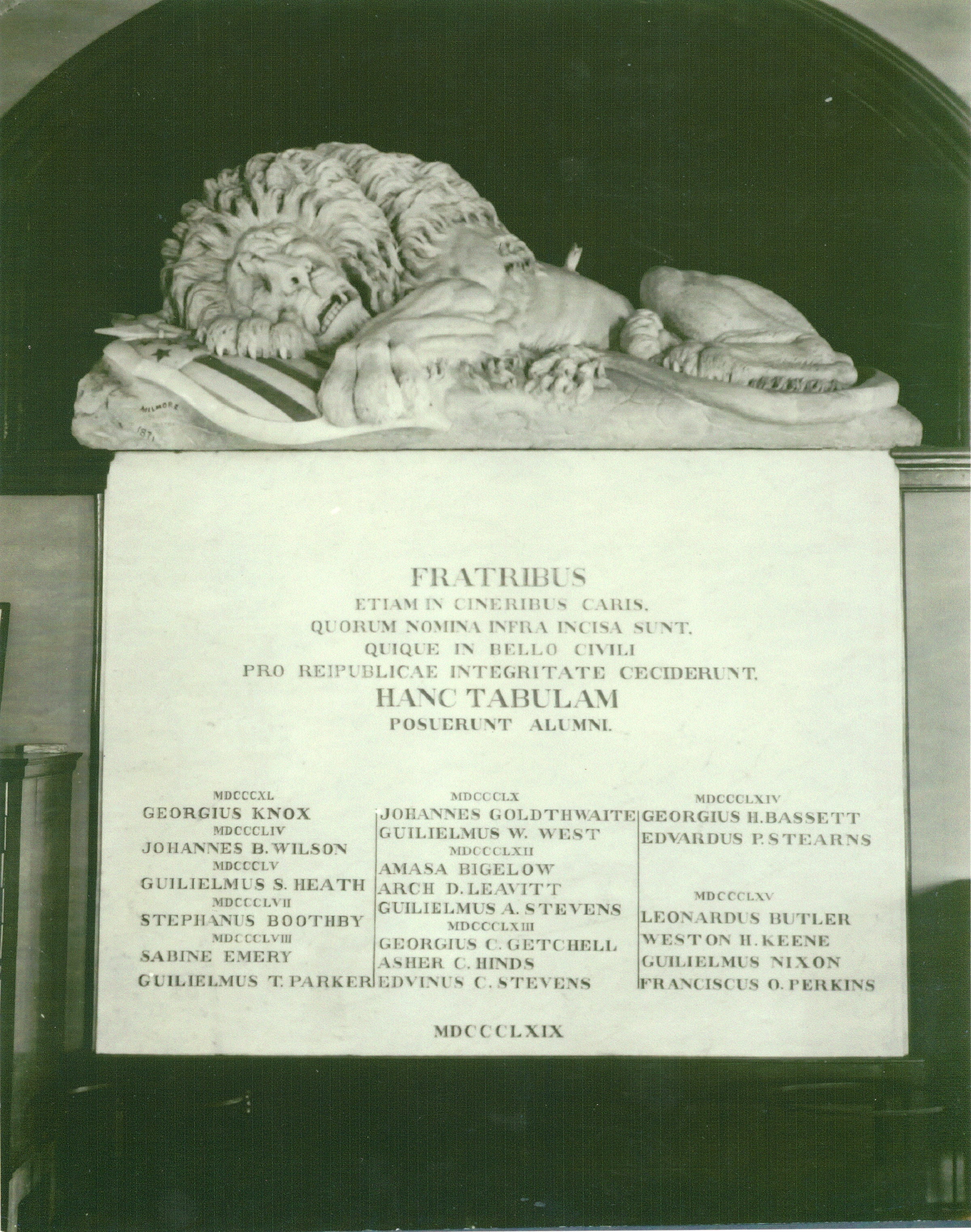
The lion — a copy, apparently, of one in Lucerne — used to occupy a place of honor in Colby College’s Memorial Hall. Now it’s in a sterile undistinguished space in the basement of the library, which seems a bit of a comedown. But it’s still pretty impressive.

Since my days of lunching (and ogling Italian girls) in Battery Park, some other monumwents have been added. There’s one to the merchant mariners of WWII, a very lugubrious affair, showing three big bronze guys on what appears to be a sinking bronze deck, and the hand of a fourth bronze guy, clearly a goner, reaching up out of the water. The hand is all you see of this fourth guy. He appears to know the answer to the last question Teacher will ever pose him. Ask me! Ask me! Before it’s too late!

There is a tablet nearby which notes that the sculpture group is based on a photo of sailors on a bit of wreckage from a torpedoed ship. The tablet also records, with a strange note of grim lip-smacking relish, that the sailors in question were not rescued, and subsequently went down with their vessel.

There is a monument to the Norwegian merchant marine, also during world war II. This consists of a roundish stone sitting on top of a flattish stone. Enigmatic people, those Norwegians. But one is glad for a respite from bronze.

And then there is the monstrosity shown up top. This is the Korean War memorial. Dunno if you can see the inscription; it reads, THE UNIVERSAL SOLDIER. There are earnest little national flags, picked out in clumsy childish mosaic, surrounding the base. I assume these were the various “allies” in the Police Action.

Questions crowd to mind. Who on earth came up with this misbegotten idea? What had he or she been doing the night before? How did the committee come to pick this one? What, in God’s name, were the other ideas?

Now the Korean War was a hell of a bad idea, and the soldiers who died there died very much in vain, I think. But they certainly deserve better than to be remembered with the title of a pop song and represented as a void — a lumpish, badly-drawn void at that.

Speaking as a [whatever]….

IMG_20130504_133550

I’ve been thinking a lot about bikes lately. Partly this is because I am riding my own more.

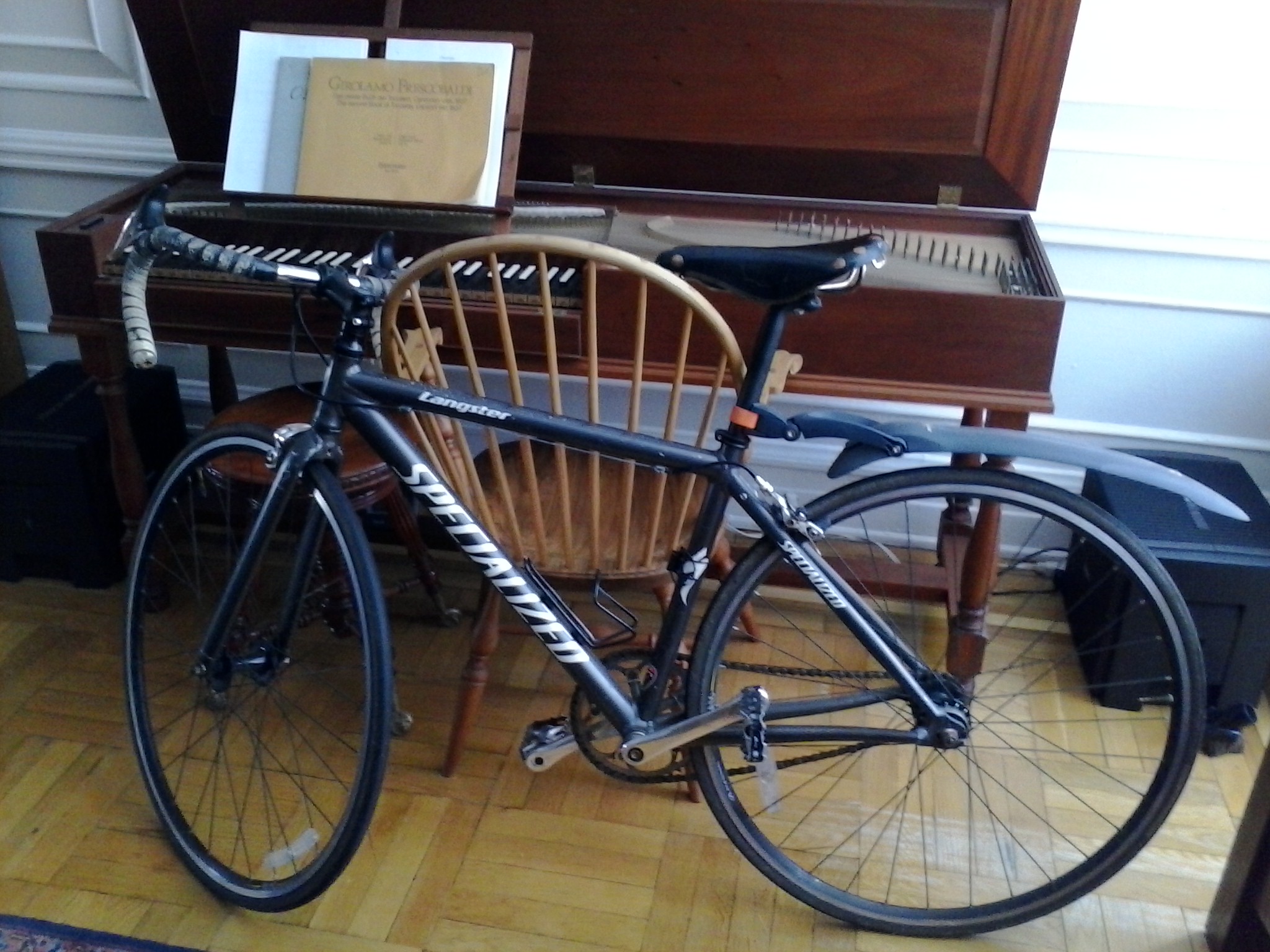
I have two. Which may be one too many, but I can explain. The one shown above — leaning against the clavichord, which occupies the only sunny spot in my apartment — is my dear old fixie, inherited from a pal who traded up. Note the way-cool Brooks leather saddle, and the desperately dorky fender. When it comes to coolth, I cover the waterfront.

Lately however I have been covering the waterfront on this little item:

IMG_20130504_133729

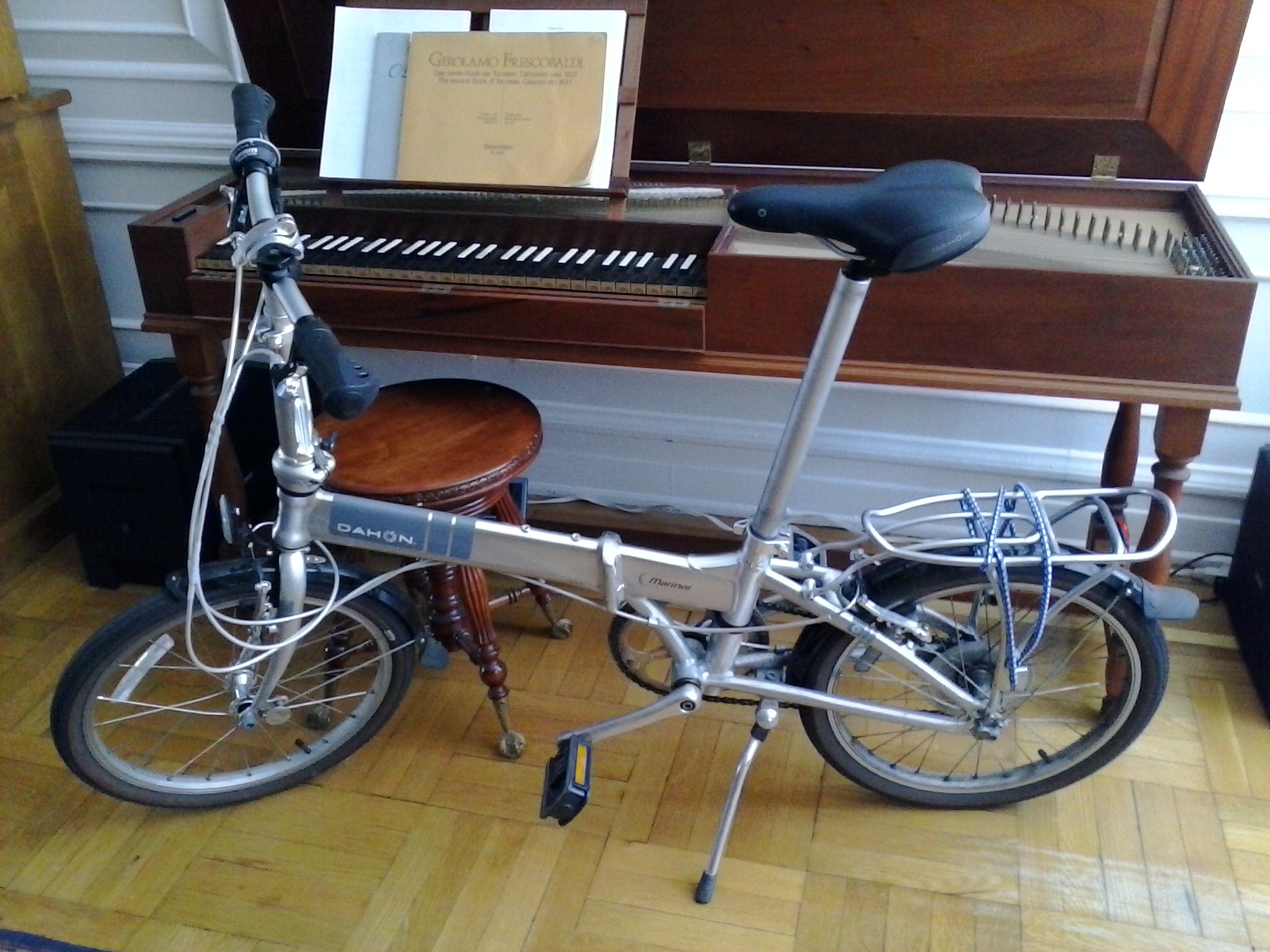
I got this bike last summer, mainly with the boat in mind. (Note the aluminum frame.) I have had the experience, in the past, of sailing up and down the coast, and finding myself in a marina or at an anchorage which is an inconvenient distance from the nearest grocery store. So having a little bike on board seemed like a good idea. Then the boat sank, leaving me with a boat bike and no boat to put it on.

However the bike has come in handy. I have a day job again, which requires me to cross the Hudson River twice a day. Now I could do this cheaply, by riding the bike down to the World Trade Center and then taking the brutish PATH train over to Joisey. But like Bartleby, I prefer not to. Instead I take the pleasanter (though more expensive) option of riding down to 39th Street and taking the ferry across the river.

Now the ferry people charge you a buck extra to take a full-size bike on board. But not a folding bike! So I can sorta economize, in an overall context of extravagant self-indulgence.

Folding bikes, by the way, have become very popular. Used to be, you hardly ever saw one. Now they’re probably a third or more of the rides I see on my commute.

I’ve also been participating more in my local cyclists’ mailing list. Again, this is partly because I’ve been riding more, and also, partly, because the list has been discussing the Five Borough Bike Tour’s anti-terrorist bag ban, discussed here earlier.

It’s been a lot of fun. There are two or three huffy wet hens with much-ruffled feathers, eager to leap to the defense of the volunteer Gestapo schtick the Tour’s managers have taken on. I’m lazy enough to like an easy target, and boy, do they provide one.

There was, of course, a certain shark — you can probably see this coming — which was bound to be jumped sooner or later. Here’s Comrade Adamantinus, jumping it:

Speaking as a Jew, I find repeated references to the actions of Bike New York being likened to actions taken by Nazis or their Vichy collaborators to be offensive in this “conversation”.

This locution has always puzzled me. Presumably Adamantinus is a Member Of The Tribe, so how else could he speak? I mean, he could hardly speak as a Gentile, could he? Or even as a Gentile does? To be sure, impersonating a Gentile is not a crime, but why would he want to do it?

Rosie O’Donnell, I believe, had a funny line about this: Speaking as a Lesbian, I’d just like to say… pass the salt.

There’s another perplexity. Presumably nobody, Gentile or Jew, likes being compared to a Nazi, or a Vichyssois for that matter. So why Adamantinus seems to think that a Gentile should be happier about it than a Jew baffles the goyische kop of this particular shaygetz.

Prof. Dr. Gen. Petraeus

God, the poor man!

Ex-General Petraeus has apparently landed a professorship with my old employer, the City University of New York. There are a number of reasons why I’m glad we won’t be colleagues, having more to do with the institution than the poor hag-ridden General.

Is that a self-tortured face, or what? Do you even get to be a general these days without doing irreparable, visible violence to your own soul? I doubt it. Or at any rate, I would like to doubt it.

The General’s appointment has stirred some grumbling among the greybeard liberal rabotniks on CUNY’s instructional assembly line. Good Lord. Where have these people been for the last what, thirty years? Do they really have no idea at all what their employer’s core business is?